
Blog Post
The most mature and successful businesses know that Network Optimization isn’t about minimizing cost. It’s about trading off multiple objectives, including cost, cash, and service. And maintaining service at the right cost is critical to maintain and grow market share.
For fast-moving consumer goods, the answer is often holding the right inventory in the right locations. Many of these businesses are already using SC Navigator to model last-mile lead time and run what-if scenarios to stay ahead of rising service expectations.
But not every industry can hold inventory to achieve fast fulfillment.
For companies producing slower-moving, larger, or more expensive goods, holding stock simply isn’t practical. Lead times may be long, but delivering on commitments remains just as important.
Why End-to-End Lead Time Matters
Industries such as heavy machinery, bulky materials like steel manufacturing, can’t economically hold enough stock to serve all demand. Industries with complex manufacturing processes or long material lead times, such as pharmaceuticals or chemicals, also need visibility and control over the entire lead time journey, not just the final leg.
Most tools only consider cost and last-mile timing, overlooking the earlier stages of the network. This makes it difficult to answer basic service-related questions with confidence.
This is why we have introduced End-to-End Lead Time Constraints in AIMMS SC Navigator.
How Does It Work?
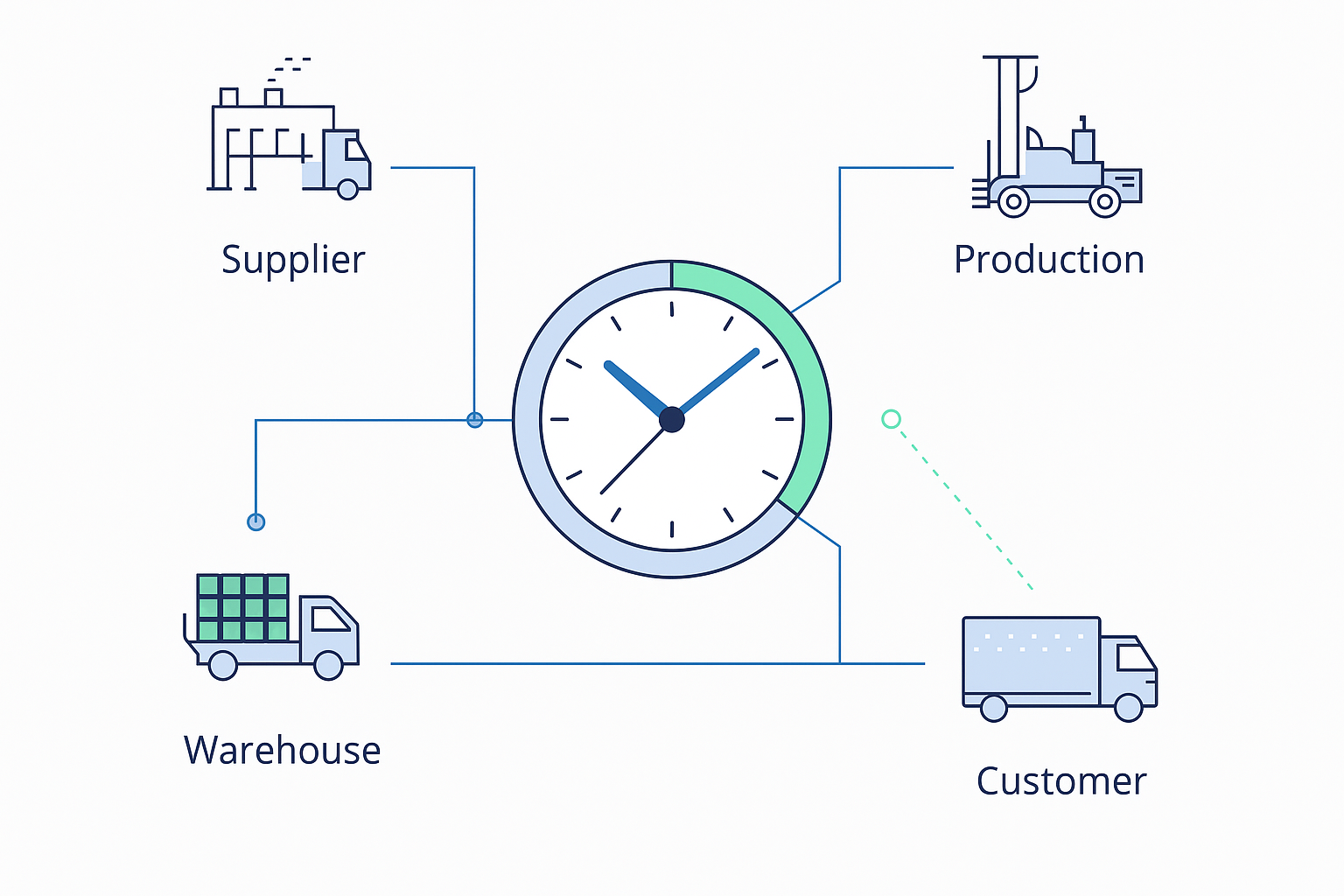
You can now add lead time components to any supplier, warehouse, production location, or transport lane. You can also specify the expected end-to-end lead time for every customer.
SC Navigator will:
- Calculate the total end-to-end lead time of different routes to customers
- Optimize the best plan to meet customer service level constraints and expectations
- Provide a clear end-to-end lead time report for each customer route

When Is It Useful?
Use this functionality if your business is struggling with questions like:
- Can we meet customer promises with the current network? If not, what needs to change?
- If we extend delivery times, will we save money? E.g., Can we close some sites or take a cheaper route to customers?
- If customers want fast delivery, what will be the additional cost? Will it still be profitable, or do we have to increase prices?
- Is one-size-fits-all service offering the right thing to do? Would it be better to offer different service times for different customers or different product types?
End-to-end lead time constraints are now available in SC Navigator. If you’re an existing customer, try it out today!
New to SC Navigator?
See how this functionality works for your network.