
Blog Post
Global supply chains are undergoing one of the most significant structural shifts in decades. The traditional model that relied on a single, centralized supply base in Asia feeding Western markets is rapidly being replaced by a multi-regional, multi-hub architecture.
Recent analyses, including Roland Berger’s 2024 report on Asia’s supply chain reconfiguration, confirm a clear conclusion:
The Asia-Pacific region is no longer just the world’s production center. It is becoming a strategically fragmented, capability-specific cluster of interconnected supply chain hubs.
This shift is reshaping global manufacturing, supplier strategy, and network design. Companies that adapt now will position themselves ahead of cost, risk, and service-level volatility. Companies that wait may find themselves navigating a network that no longer fits the economic or geopolitical landscape.
This article explores the forces behind APAC’s realignment and how organizations can use AIMMS to evaluate and optimize their future-ready supply chain footprint.
Why are APAC supply chains splitting into multi-hub networks?
For two decades, China sat at the center of global manufacturing.
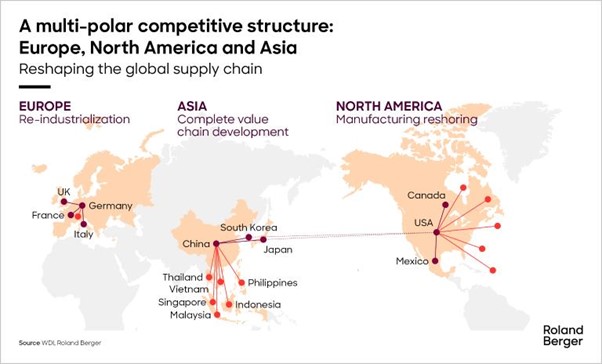
Today, the region is undergoing a more distributed configuration due to a combination of factors:
- Geopolitical pressure and trade-policy shifts
Tariff changes, export controls, and political uncertainty have created a clear need for diversification. Companies are reducing single-country dependence and spreading operations across several APAC markets to improve resilience.
- Cost dynamics and labor specialization
Labor and overhead costs are rising in China, while Southeast Asian economies such as Vietnam, Indonesia, Malaysia, and Thailand are developing differentiated industrial strengths. Examples include:
- Vietnam becoming a leader in electronics assembly
- Indonesia scaling rapidly in battery and EV-related raw materials
- Malaysia growing as a semiconductor and high-tech component hub
- Thailand gaining traction in automotive and EV production
The result is a specialized ecosystem where each country plays a distinct role in the value chain. There are new challenges, though.

The chart above summarizes the major megatrends reshaping supply chains across Southeast Asia and shows how each country is being affected. What becomes immediately clear is that no single market experiences the same pressures. Vietnam and Indonesia are heavily impacted by labor shifts, investment gaps, and rising high-tech demand.
Thailand, Malaysia, and the Philippines see strong influence from technology transfer and green-supply-chain requirements, while Singapore faces fewer manufacturing shifts but strong geopolitical and regulatory effects. This uneven landscape is driving companies toward multi-country, multi-hub network strategies, since relying on one location no longer matches the region’s structural reality.
- Regionalization of demand
APAC is no longer just an export region. Demand inside Asia is growing quickly, prompting companies to design supply chains by region, rather than funneling everything through a global hub-and-spoke system.
- Risk management and resilience requirements
Companies are increasingly required to demonstrate resilience in financial reporting and audits. This has accelerated the need to quantify risk exposure, build supply optionality, and test backup routes.
The new challenge: more options, more complexity
While this diversification offers opportunity, it also creates new complexity for global supply chain teams:
- More sourcing and production options to evaluate
- Cross-country regulatory, tax, and trade differences
- Infrastructure variability
- Highly uneven lead times, costs, and risk exposures
- Capacity and labor inconsistency across markets
- Greater uncertainty in long-term capital and footprint planning
This environment requires capabilities that most organizations do not currently have at scale:
real-time scenario modelling, rapid re-optimization, and the ability to test multiple network designs before committing.
How AIMMS supports the shift to multi-regional supply chains
AIMMS is uniquely suited to help organizations adapt to APAC’s new supply chain reality because both of its product lines address this dual need: speed + flexibility.
1. SC Navigator: Fast, visual, and trusted network design for business users
SC Navigator gives supply chain and strategy teams the ability to:
- Rapidly evaluate network scenarios
- Compare sourcing, production, and distribution footprints
- Assess cost, lead time, service, and risk trade-offs
- Simulate disruptions, and model tariffs or policy changes
- Check the impact of moving manufacturing to specific APAC locations
Business users can run scenarios in hours, not weeks, helping organizations move faster during market shifts.
See SC Navigator in action:
2. Optimization Tooling: Deep modeling capabilities for advanced APAC scenarios
For more complex or organization-specific problems, Optimization Tooling enables analysts to build custom models and apps that capture real-world details such as:
- Country-specific tariff structures
- Multi-tier sourcing constraints
- Port-level lead time variability
- Sustainability and emissions regulations
- Production line specialization
- Dynamic risk scoring
This level of flexibility is essential when designing supply chains across countries with widely different cost drivers and operational realities.
Practical APAC use-cases that companies are already exploring
Across both mid-sized and enterprise organizations, the following strategic questions are increasingly common:
1. Should we split manufacturing between China and Vietnam?
Teams use AIMMS to evaluate cost, risk, capacity, and service implications of a dual-production model.
2. What is the optimal multi-country sourcing setup for 2025–2030?
AIMMS helps map the potential footprint across Southeast Asia and compare cost-to-serve.
3. How might new trade rules impact our cost baseline?
Scenario modelling can instantly test tariff changes, export limitations, and regulatory shifts.
4. Where should we place new distribution centers to support APAC’s growing middle class?
SC Navigator helps regional teams identify optimal DC locations under varying demand forecasts.
5. Which supply routes remain viable under disruption?
Teams use AIMMS to simulate port closures, capacity shortages, or geopolitical disruptions and find alternatives.
Conclusion
Whether your team is exploring regionalization, dual-sourcing, new APAC hubs, or full network redesign, AIMMS offers both the tools and the methodology to navigate this transition with confidence.
Let's discuss your current supply chain or optimization challenges

Blog Post