

Case Study

So, your boss just came to you with that classic sentence every optimization engineer loves to hear:
“Can you build a large-scale business-critical application that lets dozens of users interact with optimization models in real time through a beautiful WebUI?”
No problem! You just need to assemble:
- A scalable API layer (FastAPI, if you’re feeling optimistic)
- A distributed job queue (Celery + Redis, if you enjoy debugging workers)
- A solver cluster (Gurobi, CPLEX, OR-Tools… pick your personality test)
- A Kubernetes setup that behaves (lol)
- A full event-driven WebSocket infrastructure
- Authentication, auditing, data versioning, scenario management, multi-user concurrency…
- And a modern UI built on React or Vue with grids, dashboards, and validation.
Just another Tuesday, right?
Let’s Walk Through the Chaos
So here’s how you’d typically go about this:
Step 1: Build a web app
React, TypeScript, data grids, live validation, caching…
Try not to cry when Chrome eats 1.2 GB of RAM just to render a table.
Step 2: Add optimization
Time to wire up your Python model. Prepare for:
- Several scripts over 1,000 lines
- Helper modules named things like
util_v3_final_final_really.py - A senior engineer who uses decorators inside generator expressions inside lambdas
- A junior engineer who quits after trying to extend that code
Extending Python optimization code written by someone else can often feel like an archaeological excavation.
Step 3: Make it real-time
Redis Pub/Sub, async event loops, concurrency locks, WebSockets.
You haven’t truly lived until you’ve stared into the void of:
RuntimeError: Event loop is closed
Step 4: Make it scalable
Kubernetes. Autoscaling. Resource limits. Ingress controllers.
At some point, you’ll question whether your actual job title is “Cloud Infrastructure Therapist.”
Step 5: Make it secure
Authentication, authorization, encrypted storage, certificate handling…
Before long, you’re writing more security code than optimization code.
Step 6: Operate it
Monitoring, logging, backups, alerts, retry logic, failover procedures, and deployment pipelines.
You’ll spend more time solving problems about your solver than solving business problems with your solver.
And after all this…
Congratulations!
After six months, dozens of YAML files, and enough caffeine to stun a moose, you’ve built a working cloud-based optimization platform.
Except for one small detail:
You just rebuilt AIMMS.
Badly. Slowly. And with tears.
The Plot Twist: AIMMS Exists
AIMMS already is the platform you just spent half a year reinventing. Everything below is included out-of-the-box:
- Multi-user support
- Role-based access
- Data validation
- Scenario management and versioning
- Automated UI generation
- Solver orchestration
- Deployment tools
- Real-time progress tracking
- Application lifecycle management
All the boring-but-critical engineering work? Already done.
You bring your optimization model. AIMMS brings everything else.
The Most Underrated Advantage: AIMMS’s Straightforward Syntax
Here’s what developers consistently underestimate:
In Python:
- Every developer codes in their own style
- Intent is often hidden in layers of function calls
- Abstractions become personal art projects
- Understanding someone else’s model is often a multi-day event
In AIMMS:
- Variables are defined as variables
- Parameters as parameters
- Sets as sets
- Constraints are declared the way you think about them
- The modeling layer is explicit, structured, and readable
AIMMS syntax is incredibly clear and transparent. This means:
Anyone familiar with AIMMS can read, understand, and extend someone else’s model quickly and safely.
This is a massive advantage for long-lived, mission-critical business models.
Every time requirements change (and they always do), AIMMS’s clarity translates directly into lower cost, lower risk, and faster delivery.
Better Syntax Enables Better Tools
Because AIMMS models are explicit and structured, AIMMS can do something Python simply cannot at the same level:
1. The Math Model Inspector
A complete visualization and diagnostic tool that:
- Shows the structure of the model
- Highlights bottlenecks
- Analyzes performance
- Provides insight into constraint interactions
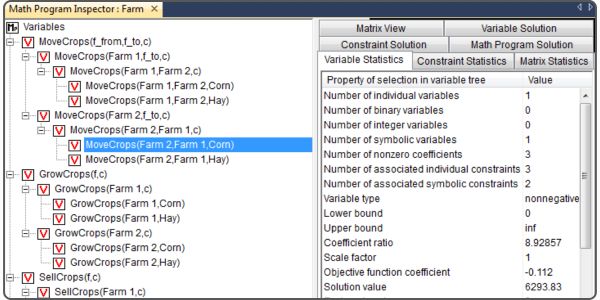
Read more on how you can analyze and debug with the AIMMS Math Program Inspector.
2. Infeasibility Analysis
A tool that:
- Automatically identifies inconsistent constraints
- Provides minimal infeasible subsystems
- Pinpoints contradictions
- Helps you fix problems in minutes instead of days
Read more about Infeasibility Analysis.
These tools exist because the AIMMS language is consistent, declarative, and integrated.
The result?
Creating and maintaining mission-critical models becomes dramatically faster and far more reliable.
The Best of Both Worlds: AIMMS + Python
Now, you might be thinking:
“Okay, AIMMS sounds great… But I still need Python for ML, data science, APIs, forecasting, and all those amazing libraries.”
We know many teams want the power of AIMMS and the flexibility of Python. That’s why we provide
- aimmspy: interact with existing AIMMS models directly from a Python script
- pyaimms: run Python scripts and statements directly from within AIMMS
So you can seamlessly combine AIMMS optimization with the full Python ecosystem.
If you want to add ML, data processing, or Python automation to your optimization workflow, the tools are ready for you.
Want to explore how AIMMS and Python work together in practice?
Let us show you exactly how to get the best of both