
Blog Post

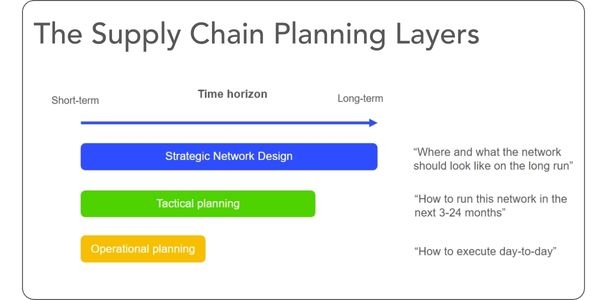
Most supply chain teams rely on strategic network design to understand what their network should look like in the long term.
But day-to-day reality makes it clear that another layer is needed, one that helps you steer the network confidently over the next 3–24 months as demand, capacity, and constraints shift.
This is where Tactical Scenario Planning (also known as Mid-Term Planning) comes in.
AIMMS SC Navigator offers supply chain leaders the ability to perform scenario planning on a strategic and tactical level. Why does this matter?
Strategic network design answers where and what your network should look like in the long run.
Tactical scenario planning answers how to run that network over the next 3–24 months as demand, capacity, costs, and service constraints shift.
Combining both lets you make confident trade‑offs on cost, service, risk, and emissions and quickly turn decisions into action.
The gap tactical planning closes
Most teams use Network Design to test structural changes (open/close sites, supplier switches, modal shifts). But the day‑to‑day reality brings:
- Demand volatility (seasonality, promotions, product ramps)
- Inventory challenges (cost-profit trade-offs, shortages)
- Supply variability (supplier delays, lead‑time changes, shutdowns)
- Capacity constraints (labor, production, warehouse, transport lanes)
- Cost volatility (freight price changes for ship/air/rail/road)
Tactical planning addresses these with multi‑period models (monthly or weekly buckets) that keep your network structure fixed and explore how to operate it. It’s the missing link between strategic design and S&OP/S&OE.
What “tactical” means in practice
Horizon: typically 3–24 months.
Time buckets: months or weeks
Lead Times: Long lead times can cross time buckets. For example, supplier delivery lead times, long manufacturing batch sizes, and long duration sea freight.
Decisions:
- Where to make and stock each product, and how much
- Which lanes and modes to use and when
- How to allocate limited capacity for productions and warehouses
- When and where to build and draw down inventory
KPIs: total landed cost, contribution margin/EBITDA, service, CO2, utilization, inventory, and working capital.
Why supply chain teams should care
- Faster time from question → decision → action
Run “what‑ifs” on seasonal builds, constrained capacity, or supplier hiccups without re‑designing the whole network. - Decisions stay relevant longer
Because the horizon is near-to-mid-term, scenarios reflect current prices, constraints, and lead‑times, not last year’s assumptions. - Cross‑functional buy‑in
Show trade‑offs in the metrics that each team owns (Finance: EBITDA; Ops: utilization & service; Sustainability: CO2). - Risk‑aware planning
Stress‑test disruptions (port closure, lost line, yield drop) and pre‑agree playbooks. - Realistic feasibility
Model supply/production/transport lead‑time offsets so the plan can actually be executed.
Example scenarios to run this quarter
- Seasonal build plan: How much inventory to pre‑build without excessive working capital?
- Capacity shortfall: Which products/customers to prioritize if a critical line drops capacity by 20%?
- Supplier delay: What is the cost‑to‑serve impact and best re‑routing if inbound lead‑time stretches by 3 weeks?
- CO2 budget: What mix of modes meets a monthly CO2 cap with the least service impact?
- Price volatility: If ocean spot rates spike for 2 months, when do we switch to alternative ports or modes?
How AIMMS SC Navigator supports this
- Strategic + Tactical Planning in one app.
- Scenario Navigator to compare many what‑if side‑by‑side scenarios simultaneously
- Multi‑objective modeling to balance cost, service, risk, and sustainability.
- Lead‑time offset so flows that span multiple buckets are timed correctly.
- End-to-End lead time constraints for make-to-order products.
- Finance‑ready outputs (e.g., profit, cost to serve) to align decisions with the P&L.
What good looks like
- A reusable and updated digital twin of your network with monthly/weekly buckets
- A curated library of approved playbooks for common disruptions
- A quarterly cadence to refresh scenarios and feed S&OP
- Measurable improvements in cost/service/CO2 trade‑offs
Frequently asked questions
1. Is tactical planning just S&OP?
No, tactical planning is an optimization‑driven and scenario planning based, multi‑period extension of network design that feeds S&OP with feasible options and quantified trade‑offs.
2. Will this slow us down?
Not if you standardize data inputs and scenario templates. Most teams can go from question to answer in days, not weeks, once the model is set up.
3. What data do we need?
Demand (by SKU/location/time), BOMs/yields, capacities, costs & tariffs, service targets, lead‑times, and policy constraints.
4. How does Strategic and Tactical planning compare?
| Planning Dimension | Strategic | Tactical |
|---|---|---|
| Making changes to the physical supply chain network? | Yes | No |
| Time horizon | 3-5+ years | 3-24 months |
| Time buckets | Yearly | Monthly |
| Investment type | CAPEX | OPEX |
| Type of decisions | Structural, capital-intensive, high-impact; infrequent | Recurring, operational, execution-oriented; revisited often |
| Data requirements | Aggregated | More detailed |
| Motivation | Cost reduction, resilience, carbon footprint optimization, structural redesign, and M&A decisions | Improve service levels, reduce operating costs, balance demand/supply, and reduce firefighting |
| Savings & ROI | High savings, longer ROI | Lower savings compared to strategic, but faster ROI |
Closing thoughts
If you’re evaluating Network Design tools, make sure they don’t stop at the long‑term blueprint. Tactical scenario planning brings your design to life, every week and every month, so you can steer your network through volatility with confidence.
Don’t wait for the next planning cycle
Discover how SC Navigator helps leading companies make faster, data-driven network decisions, again and again.