

Blog Post

The EU-Mercosur agreement, sealed in January 2026 after decades of talks, spans roughly 700 million people and eliminates tariffs on about 91 percent of traded goods between the blocs. Read more about the deal here.
For supply chain and COE teams, especially in the manufacturing, energy, oil and gas, retail, and transportation sectors, this deal accelerates cross-continental flows and opens new opportunities, but also reveals gaps in current network designs.
From both EU and LATAM perspectives, the shift demands agile planning that goes beyond static spreadsheets. Here’s how it plays out across key sectors, with practical steps to adapt.
Which sectors see the biggest network shifts?
Manufacturing
European machinery, chemicals, automobiles, and pharmaceuticals gain smoother access to Brazil, Argentina, Paraguay, and Uruguay markets. EU exporters can expect rising demand that stretches existing port and distribution capacity, while calling for stronger footholds closer to customers in Mercosur hubs like Santos or Montevideo.
From the LATAM side, local manufacturers in autos and assembly gain easier sourcing of high-quality European components and equipment. This supports scaling production but requires balancing imports against domestic capacity to avoid over-reliance.
Quick pro tip:
Run a greenfield analysis across EU-LATAM lanes to map total cost-to-serve by origin-destination pair. Identify optimal DC locations and flow balances that absorb volume growth while maintaining service levels. Refresh monthly as trade patterns solidify.
Energy, oil, and gas
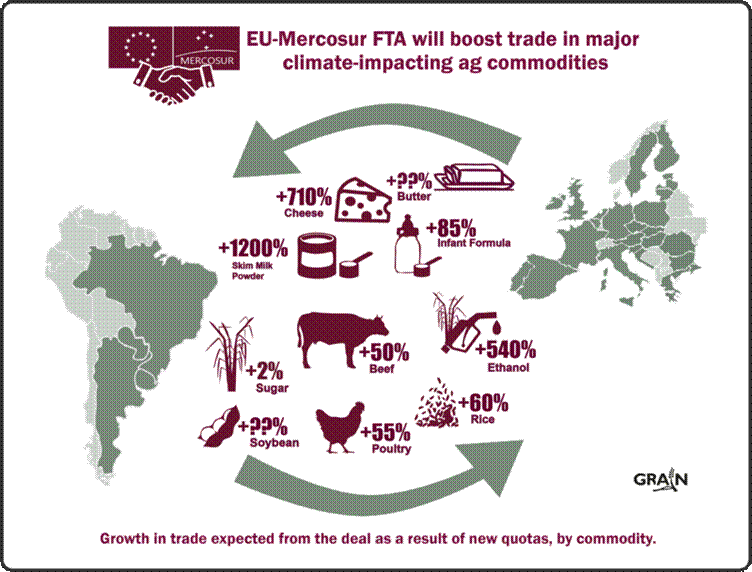
EU energy firms benefit from steadier access to Mercosur lithium, copper, nickel, cobalt, biofuels, and ethanol, supporting battery production and renewables projects with more reliable mid- and long-term flows.
LATAM producers, particularly in Brazil and Argentina, diversify export destinations beyond traditional US and Asian buyers. This strengthens revenue stability but tests the underdeveloped port and rail infrastructure under higher volumes.
Quick pro tip:
Build multi-modal path models from origin mines and plants to destination refineries and factories. Test price and capacity sensitivities to prioritize routes with headroom. Use outputs to guide forward commitments and alternative sourcing options.
Retail
EU retailers and FMCG companies lower input costs through duty-free machinery and chemicals for processing and packaging, while premium exports like wine, cheese, and chocolate find receptive LATAM markets with protected labels.
LATAM retail chains welcome broader assortments of European consumer goods at competitive prices, enabling richer shelf options but requiring adjustments to inventory strategies for faster-turning imports alongside local staples.
Quick pro tip:
Segment SKUs by trade exposure and run rolling demand forecasts tied to new flow patterns. Optimize forward stocking locations near borders and ports to shorten cycles and sustain high service through volume ramps.
Transportation and logistics
EU 3PLs and carriers position for increased southbound industrial shipments and northbound commodities, gaining leverage to expand Atlantic capacity and specialized services.
LATAM logistics providers capitalize on export growth from agribusiness to minerals, strengthening regional networks while competing for higher-value EU return loads.
Quick pro tip:
Validate executability before optimization.
Identify the specific mine-to-EU corridors that would carry Mercosur lithium, copper, nickel, and cobalt, and quantify where incremental volume can realistically move given current rail, port, and shipping utilization. Exclude routes that already rely on peak-load operations or face persistent congestion.
On the remaining corridors, run focused sensitivity tests (such as a 30 percent lithium price increase under stricter EU carbon rules or EV mandate shifts) to check whether margin, delivery timing, and contract economics remain intact under stress. Commit forward contracts only where both the economics and the physical network remain viable across those scenarios.
Building networks that evolve with trade
These changes compound across borders. Gradual market openings create sustained volume growth, while product quotas and infrastructure limits add complexity to planning. External factors like currency swings or policy updates amplify the need for flexibility.
According to a new report from the World Economic Forum, global supply chains have entered a new phase of structural volatility, forcing companies and governments to rethink where and how they invest and produce.
This new report finds that 74% of business leaders now see resilience as a driver of growth rather than a cost.
Conclusion
New ways of operating are necessary. Center of Excellence (COE) teams in EU and LATAM must evolve from periodic studies to dynamic models: refresh lane costs and capacity monthly, test network resilience quarterly, and translate results into clear metrics on service, total cost, and sustainability. This positions your business ahead of competitors still reacting to yesterday’s data.
Start with one lane or sector today. The companies that redesign first will own the new trade reality.
Let's discuss your current supply chain or optimization challenges