

Blog Post
When the Strait of Hormuz closes, the shockwaves don’t stop at port. They reach government offices in Manila (they were forced to introduce 4-day work week nationwide!) and supply chain planning desks everywhere in between.
Also, geopolitical disruptions to global trade are not black swans anymore. They are a recurring feature of the operating environment. The Suez Canal blockage of 2021, the Panama Canal drought of 2023–24, the Red Sea–Houthi crisis of 2024–25, and now the effective closure of the Strait of Hormuz since late February 2026, each event caught supply chain teams scrambling to answer the same questions under pressure:
Where exactly are we exposed? What are our alternatives? What does each option cost? How do we execute?
The problem is not that these disruptions are unforeseeable. Analysts and risk consultants had modelled Hormuz closure scenarios for years. The problem is that most supply chain organizations lack the tools and processes to translate scenario thinking into executable plans fast enough to matter when a crisis actually hits.
The pains that emerge when a chokepoint closes
Whether the disruption is Hormuz, or the next crisis, the same five organizational failures tend to appear within the first 72 hours.
1. No clear picture of actual exposure
Teams know roughly which regions or suppliers are affected, but not precisely which flows, which SKUs, or which customer commitments are at risk. The Hormuz closure cut off Jebel Ali — the Middle East’s largest container hub — along with Dammam, Hamad Port, and effectively the entire Persian Gulf container cluster. Companies with Gulf-origin suppliers or Gulf-market customers had real exposure. But many could not quantify it quickly because they had no mapped, queryable baseline of their network flows. Without that, every response decision is based on instinct.
2. Too many interacting variables for manual analysis
Geopolitical disruptions rarely present a single clean problem. Hormuz combined port closures, Cape of Good Hope rerouting adding 18–22 days of transit time, war-risk insurance surcharges of $800–$1,500 per container, severe congestion at bypass ports like Khor Fakkan and Fujairah, land-bridge trucking from Jeddah across 950–1,400 km of road with no rail alternative, and a simultaneous resurgence of Houthi attacks in the Red Sea. Each of these dimensions affects costs, lead times, and inventory requirements differently, and they interact. A spreadsheet can hold one or two of them. It cannot hold all of them simultaneously while optimizing across the full network.
3. No way to compare options side by side
The executive team wants answers to specific questions: How long can we absorb this before it materially impacts customers? What is the cost difference between the Jeddah land-bridge and rerouting via India transshipment? At what duration of disruption does nearshoring become economically rational? These are legitimate questions and without structured, comparable scenario outputs, planning meetings produce debate rather than decisions. Leaders end up making high-stakes calls on the basis of whoever made the most persuasive argument in the room.
4. Strategy and execution are disconnected
Network-level decisions (ex: which ports to use, where to hold buffer stock, which supplier relationships to activate) are made by one team. Route-level decisions (which truck corridors, which fleet sizes, which delivery schedules) are made by another, often with different data and different tools. The result is strategic plans that look coherent on paper but fall apart when someone tries to actually run the trucks.
5. The cost of resilience is never quantified
When leadership asks whether the company should invest in supply chain redesign like dual sourcing, new distribution nodes, repositioned inventory, the answer should be a number: the point at which redesign is cheaper than absorbing ongoing disruption costs. Without modelling of alternative network configurations, analysts cannot produce that number. The investment case for resilience remains perpetually fuzzy, and it loses to more immediate budget priorities. Until the next crisis arrives.
From exposure map to scenario decisions
SC Navigator is designed for analysts who need to model complex trade-offs across cost, service level, risk, and CO2 simultaneously, and to do so in a structured, repeatable way.
Build Your Baseline Quickly with Whiteboard
For teams without a formal network model, SC Navigator is built for supply chain analysts and the ability to get started asap (see how it works here). Analysts sketch their network visually, suppliers, production nodes, warehouses, customers, and transport lanes, on an interactive canvas that immediately converts into an optimization-ready data model. There is no need to build complex spreadsheet templates from scratch.
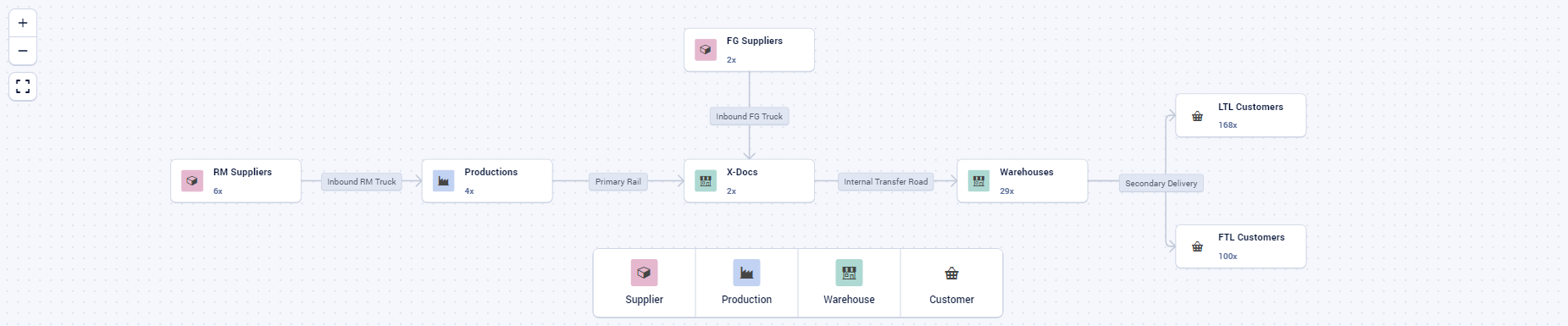
Once data is loaded, SC Navigator’s geographic map visualisation lets you filter all active flows by lane, mode, region, or origin-destination pair. In a Hormuz context, this makes it immediately visible which flows transit the Gulf and which customer commitments are at risk. In any future crisis, the same view applies: filter for the affected region and your exposure register appears.
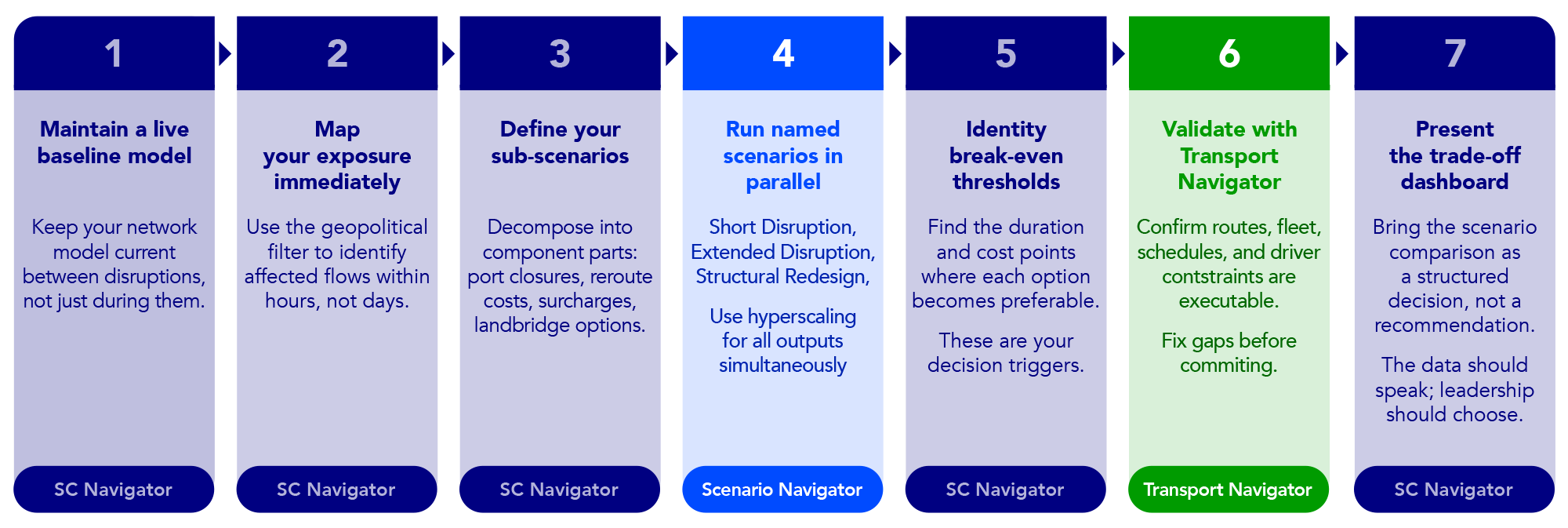
Best practice: Maintain a live baseline model, not just a crisis-period one. The value of a network model built during a crisis is limited. The value of one that was built before the crisis and kept current, is transformational.
Decompose and combine scenarios with Scenario Navigator
Scenario Navigator allows analysts to define discrete sub-scenarios — individual, well-defined changes to a subset of base data — and combine them into composite network scenarios.
For the Hormuz crisis specifically, useful sub-scenarios include:
- Primary hub offline: Jebel Ali at zero capacity; Gulf ports similarly closed
- Extended reroute: 18–22 days added to Asia–Gulf lanes; proportional fuel cost increase
- Landbridge active: Multimodal leg to Jeddah plus road haulage at realistic per-container costs
- Alternative transhipment: Nhava Sheva or Colombo as intermediate hubs for onward Gulf feeder services
- Surcharge layer: War-risk and bunker surcharges applied as per-TEU lane cost uplifts
The same sub-scenario logic applies to any chokepoint disruption. For a Panama Canal closure, the sub-scenarios would cover the Panama reroute cost and time premium, US East Coast versus West Coast port substitution, and inland rail alternatives. The structure is identical while only the parameters change.
Combine sub-scenarios into three named network scenarios as a minimum: a Short Disruption baseline (cost absorption, minimal structural change), an Extended Disruption scenario (full rerouting, bypass infrastructure, elevated inventory), and a Structural Redesign scenario (sourcing diversification, new nodes, permanent network reconfiguration). SC Navigator’s hyperscaling capability runs all scenarios in parallel, compressing the time from analysis to decision.
Best practice: Always build the Structural Redesign scenario, even when a disruption appears short-lived. The insights it generates — which sourcing configurations, inventory locations, and routing alternatives are genuinely resilient — are the inputs to long-term network investment decisions that cannot be deferred indefinitely.
Quantify the Cost of Resilience
For each scenario, SC Navigator produces optimised total network cost, service level attainment, and inventory investment. The side-by-side comparison is what converts planning from a debate into a decision.
The critical questions this comparison answers for Hormuz and for any major geopolitical disruption:
- Which bypass route is cheaper? Centre of Gravity analysis identifies the optimal configuration for your actual customer distribution, not a generic one.
- What does the inventory uplift cost? Additional transit time and variability mean higher safety stock requirements. Inventory module calculates the exact working capital impact of each routing option, ensuring that freight cost comparisons include the full picture.
- When does structural redesign pay off? At what number of weeks of sustained disruption does the cost of dual sourcing or new inventory nodes become lower than the cost of continued bypass routing? SC Navigator answers this with a number, not an opinion.
Closing the Gap Between Strategy and Execution
SC Navigator answers the strategic question: what should the network look like? Transport Navigator, the operational planning module within SC Navigator, answers the tactical question: how do we execute it?
This gap is where good plans fail. A network model may identify Jeddah-to-Riyadh landbridge trucking as the optimal bypass solution. Transport Navigator is what determines how many vehicles are needed, on which fixed routes, running on which days, at what fleet utilization and whether the plan is operationally feasible before the company commits to it.
Transport Navigator uses advanced mathematical optimization, combining heuristics with a best-of-breed solver, to design fixed routes and determine optimal fleet size across delivery performance, vehicle capacity, and cost efficiency simultaneously. It handles constraints that spreadsheet routing tools cannot: driver hours, time windows, layover requirements, multi-period volume fluctuations, and backhaul opportunities.
For geopolitical bottleneck scenarios, Transport Navigator addresses four specific challenges:
- Fleet sizing for new corridors. When disruption activates previously marginal or unused landbridge corridors — as Hormuz has done for the Jeddah–Riyadh, Khor Fakkan–Dubai, and Salalah–UAE routes — operators need to know rapidly what fleet is required to maintain service levels. Transport Navigator optimises the fleet mix, including the split between own fleet and third-party capacity.
- Fixed route design under crisis conditions. New high-volume corridors require route design from scratch: stop sequences, dispatch schedules, delivery windows. Transport Navigator builds these routes optimally, not heuristically, which matters when every unnecessary kilometre is an avoidable cost.
- Multi-period planning for volatile volumes. Crisis-period flows are not stable. In the Hormuz context, demand for essential goods surges while discretionary categories compress. Transport Navigator’s multi-period capability models different volume assumptions week by week, allowing fleet deployment to adjust accordingly rather than being locked to a single crisis-period average.
- Backhaul optimization. When containers are being repositioned through non-standard ports and hinterland corridors, return-leg load opportunities become economically significant. Transport Navigator identifies backhaul options explicitly, reducing the unit cost of operating new land-bridge routes.
Best practice: Run Transport Navigator on your preferred SC Navigator scenario before presenting it to leadership. A plan that optimizes well at the network level but requires an impractical fleet configuration or unacceptable driver schedules is not a viable plan. Operational validation at this stage prevents expensive commitments to strategies that cannot be executed.
A Repeatable Workflow for Any Geopolitical Disruption
The following workflow applies to Hormuz today, and to whatever the next disruption is. This is a quick guide on how to build the muscle and be proactively prepared.
Conclusion
The supply chain organizations that will navigate these disruptions most cost-effectively are not those with the most sophisticated reactive capabilities. They are those that have built the planning infrastructure beforehand — a live network model, a library of tested sub-scenarios, a validated playbook for each major chokepoint — and who reach for that infrastructure the moment a new crisis begins, rather than starting from scratch under pressure.
Let's discuss your current supply chain or optimization challenges