
Blog Post

There is a particular kind of organizational delusion that happens when a powerful new technology arrives. Leaders read the analyst reports. They attend the conferences. They approve the budget. They tell the board they are “leaning into AI.” Then, about 18 months later, they are sitting in a room wondering why the ROI presentation looks like a seismograph during an earthquake.
That is where a significant portion of supply chain organizations sit today with AI.
Not because the technology is a fraud. It is not. But because the gap between what was promised, what was planned, and what was actually built is wider than most teams are willing to admit in public.
Let us look at what the data says.
The Numbers Do Not Lie (But They Do Embarrass)
Gartner analyzed more than 35 million job postings between Q1 2023 and Q1 2026. Their June 2026 finding: demand for supply chain roles requiring AI skills has grown 387% in three years. That is not a rounding error. That is a structural shift in what companies believe they need.
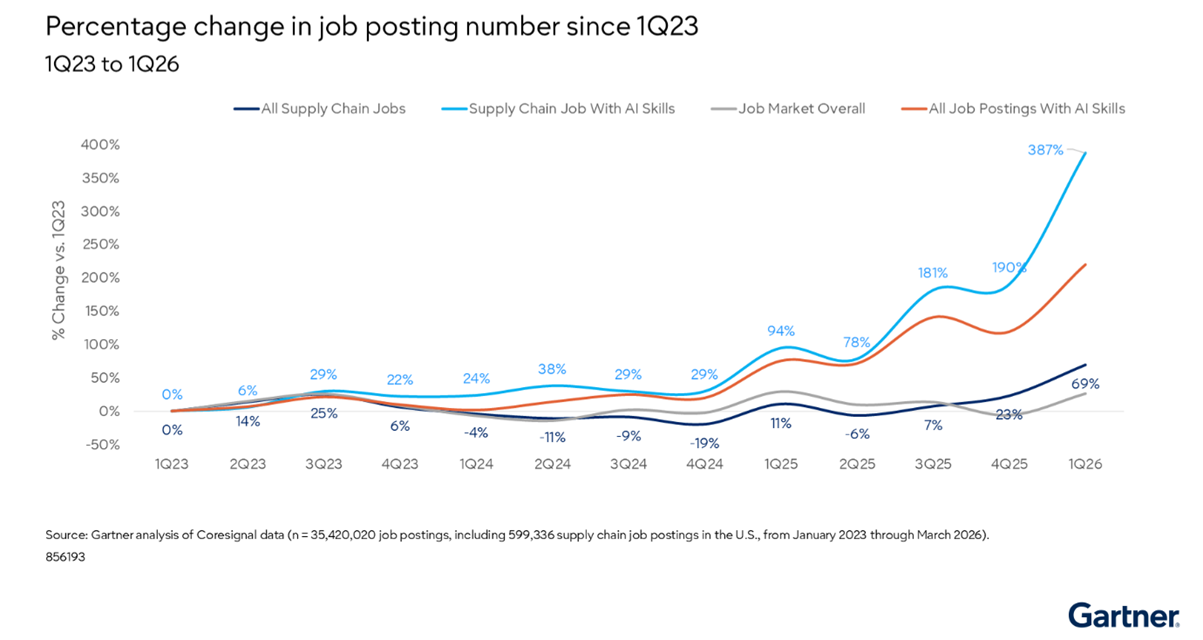
And yet, according to a separate Gartner survey of 140 senior supply chain leaders at organizations with $250M or more in annual revenue, 56% say integrating AI with legacy systems is a major challenge, and 50% say they lack the internal expertise to implement and manage AI.
Read that again. Companies are racing to hire AI talent while simultaneously admitting they cannot deploy AI effectively.
The same Gartner research found that only 17% of supply chain organizations are pursuing immediate transformational redesign of their processes. The remaining 83% are either applying AI incrementally to specific use cases, or gradually scaling it into existing processes. In other words, the vast majority are bolting new technology onto old foundations and wondering why the walls are cracking.
Gartner’s Snigdha Dewal put it plainly:
“The greatest friction point in scaling AI today isn't the technology itself, but the legacy environments in which it is being deployed.”
The Augmentation vs. Automation Trap
Here is the strategic mistake many supply chain leaders are making. They framed AI as an automation play, one that would reduce headcount, cut costs and improve throughput, when the evidence consistently points to augmentation as the higher-value path.
Harvard Business Review’s April 2026 analysis of companies choosing AI augmentation over automation found a clear strategic fork: automation targets the bottom line through cost reduction, while augmentation targets top-line growth through smarter decision-making. The distinction matters enormously for how you design your AI rollout, what metrics you track, and what your team is incentivized to do.
MIT Sloan’s research reinforces this. Their findings suggest AI is far more likely to complement human workers than replace them outright, particularly in roles requiring contextual judgment, domain expertise, and the kind of situational reading that comes from years of living inside a complex supply chain.
Supply chain planning is precisely that kind of role. The best planners are not better at running spreadsheets. They are better at knowing which data to trust, which constraints are real versus political, and when the model is telling you something useful versus when it is confidently wrong.
No LLM built on generic training data replicates that. Not yet. Possibly not ever, for the most complex decisions.
The Decision-Making Problem Nobody Is Talking About
Deloitte’s 2026 Global Human Capital Trends report, drawing on surveys of more than 9,000 business and HR leaders across 89 countries, surfaced something that should concern any supply chain VP: 60% of executives now regularly use AI to support their decisions, but only 5% consider themselves leading the way on AI-enabled decision-making.
That gap, between use and mastery, is where risk lives.
Deloitte found that more than half of organizations operate at low decision-making maturity, with few systematically teaching decision skills or providing the tools to support better choices. When AI is layered on top of low-maturity decision processes, the result is not better decisions at scale. It is worse decisions at scale, faster.
There is also a more subtle problem: when AI makes the recommendation, humans feel less ownership over the outcome. Research cited by Deloitte shows people become more likely to be dishonest when delegating decisions to AI, and less likely to catch errors when they assume the model has already checked. In supply chain terms, that means missed disruptions, compounding forecast errors, and network designs that look optimal on paper and fall apart under real operational pressure.
The antidote is not less AI, but better human-AI collaboration architecture. This means explicit decision rights, override mechanisms, escalation paths, and governance that treats AI as a powerful but fallible adviser, not an oracle.
Where Mathematical Optimization Fits. And Why Most AI Doesn’t
Not all AI is the same. And for the decisions that actually move the needle in supply chain, network design, facility location, flow optimization, trade-off analysis across cost, service, and sustainability, the relevant tool is not a language model. It is mathematical optimization.
AWS published a detailed technical brief in June 2026 laying out this split. AWS calls machine learning inductive AI, because it generalizes from many examples into a probability. It calls optimization deductive AI, for the opposite reason: it starts from the constraints and objectives you define and calculates the one answer that satisfies all of them, rather than estimating the likeliest one.
That distinction matters at operational scale. “This route is probably efficient” is a different kind of output than “this is the optimal route given every constraint in your system.” For pattern recognition and demand forecasting, probabilistic is fine. For decisions with hard constraints, physical capacity limits, regulatory compliance, time windows, multi-echelon trade-offs, you need mathematical certainty, not a confident approximation.
The AWS evidence is concrete. Their work on Amazon’s EU logistics network (90 warehouses, 34 sort centers, 242 distribution stations, and over 11,000 paths) illustrates the scale at which these problems operate. Machine learning models handle demand forecasting across the network. But deciding when trucks should depart while satisfying shift schedules, capacity constraints, and spacing requirements requires optimization. The result of combining both: 20 to 50 basis point improvements in next-day delivery coverage, translating to tens of millions of dollars in business value.
That is not a pilot result. That is a production result at one of the most operationally complex logistics networks on earth.
The pattern is consistent. High-constraint, high-stakes, high-complexity operational decisions respond to mathematical optimization. Probabilistic AI, deployed in isolation, simply does not.
What Actually Works
The pattern across organizations seeing above-average returns from AI investment in supply chain is consistent. It is not the technology that differentiates them. It is the architecture around it.
- They separate the AI from the decision. AI generates the scenario, the recommendation, the sensitivity range. A human with domain context makes the call. The override is never more than one click away, and the reasoning behind the AI recommendation is always visible.
- They fix data before deploying models. Gartner’s May 2026 survey found that data gaps remain one of the primary constraints on AI-powered orchestration in supply chain. Organizations that skipped the data foundation phase and went straight to model deployment are producing expensive, confidently wrong outputs.
- They treat mathematical optimization and AI as different tools for different jobs. This is the distinction that most vendor marketing actively obscures. A large language model is a probabilistic text machine. A mathematical optimization solver is a deterministic engine with provable bounds. For decisions involving facility location, network flow, and trade-off analysis across cost, service, and sustainability, you need the latter, augmented by the former.
This is the architecture AIMMS has built for supply chain network design: mathematical optimization as the foundation, with AI built in as the interface layer that makes optimization more accessible and faster to act on. Their SENSAI capability allows business users to interact with complex optimization models conversationally, run scenario comparisons, and prepare data for modelling, without replacing the underlying rigor that makes the answers defensible. The LLM handles the experience. The solver delivers the answer. Those are not the same thing, and conflating them is where most AI-in-supply-chain initiatives quietly fail.
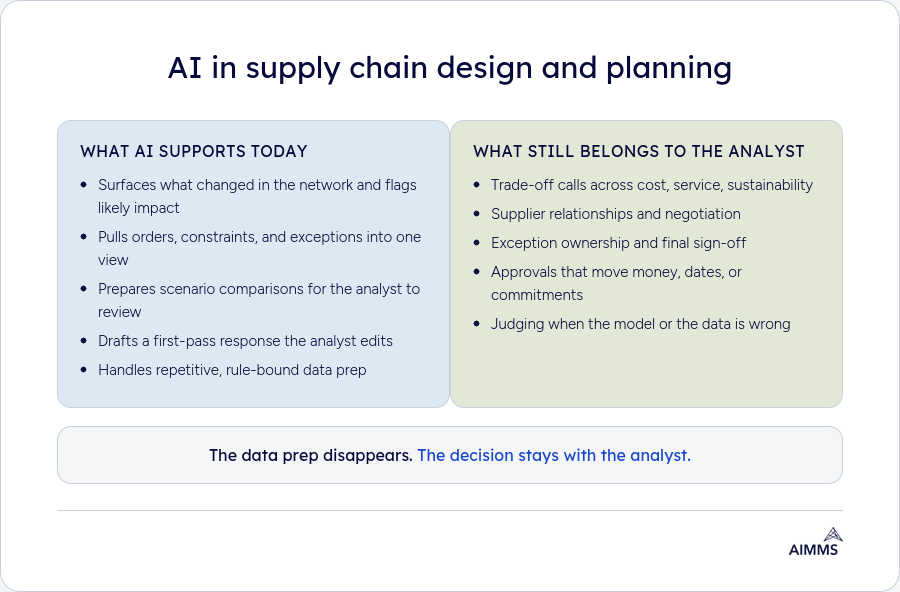
In AIMMS SC Navigator, that separation is concrete: SENSAI takes on the network monitoring, data prep, and scenario drafting, while the analyst keeps every call that involves a trade-off, a relationship, or a judgment about whether the model is right.
The Honest Assessment
Supply chain leaders should be asking themselves if they’re buying AI capability, or the appearance of AI capability?
The difference shows up in results. Organizations that have pursued genuine augmentation, leveraging human expertise amplified by purpose-built AI layered on proven mathematical models, are seeing better scenario coverage, faster decision cycles, and network designs they can actually defend to the board.
Most supply chain leaders are buying the appearance of AI capability, not the capability itself. The results make the difference obvious.
Organizations pursuing genuine augmentation, human expertise amplified by purpose-built AI layered on proven mathematical models, are seeing better scenario coverage, faster decision cycles, and network designs they can defend to the board.
Organizations that bolted a general-purpose AI interface onto legacy processes are generating impressive demos and disappointing quarterly reviews. That is the gap between looking transformed and being transformed.
The Gartner data, the Deloitte research, and the MIT Sloan evidence all point to the same conclusion: AI in supply chain delivers when it augments domain expertise, not when it tries to replace it. It works when the data is ready, the decision rights are clear, and the humans in the loop are treated as an asset, not a placeholder on the way to full automation.
The 387% surge in demand for AI-capable supply chain talent is a market correction. Experienced supply chain professionals who can work effectively with AI are about to become the scarcest, most valuable people in the industry.
Organizations that build that capability now will set the pace. Organizations that wait will be bidding for it later in a hiring market that is already running dry.
Explore more about our new AI developments at: aimms.com/ai-capabilities
Ready to see what mathematical optimization built into SC Navigator does for your own network: