
Blog Post

We spend years perfecting how a product reaches the customer, and then, the moment it arrives, we stop paying attention.
For most supply chains, that’s fine: the packaging is emptied, flattened, and thrown away. But for a growing number of businesses, the packaging is the asset. The crate, the pallet, the temperature-controlled container — expensive, durable, reusable, and completely useless until it comes back, gets cleaned, and goes out again.
That model used to be a niche. It isn’t anymore.
Sustainability targets are turning single-use packaging into a liability, the economics of reuse improve every time material and transport costs rise, and regulation is now forcing the issue.
The EU’s Packaging and Packaging Waste Regulation sets minimum reuse targets for transport packaging, moving reusable assets from “nice initiative” to “compliance requirement.”
Circular supply chains are arriving whether companies are ready to optimize them or not.
And here’s the catch: optimizing one is a fundamentally different problem from the one most supply chain teams and most supply chain software were built to solve.
What Is a Circular or Pooling Supply Chain?
Strip away the industry specifics and a circular, or “pooling,” supply chain works like this: a finite fleet of reusable assets is sent out loaded with goods, used at the destination, returned empty, reconditioned, and sent out again. The asset is rented, not sold.
The operator’s job is to make sure a clean, available asset is in the right place at the right time over and over, for years. It shows up everywhere once you look for it.
A fresh-produce crate pool circulates millions of folding trays between growers, depots, and retailers, washing and re-sorting them between trips.
A pharmaceutical cold-chain fleet sends temperature-controlled containers across the world, then routes them through service centres to be inspected, repaired, and pre-conditioned before the next shipment.
Different industries, same underlying shape: a loop, not a line.
How a Circular Supply Chain Differs From a Forward Supply Chain
This is where intuition built on conventional supply chains quietly breaks.
In a forward supply chain, the logic is one-directional. Product flows from source, through ports and warehouses, to the point of demand, where it’s consumed, and the flow is complete.
Optimization is essentially a question of the cheapest path from supply to demand. The packaging is an afterthought, if it’s modeled at all.
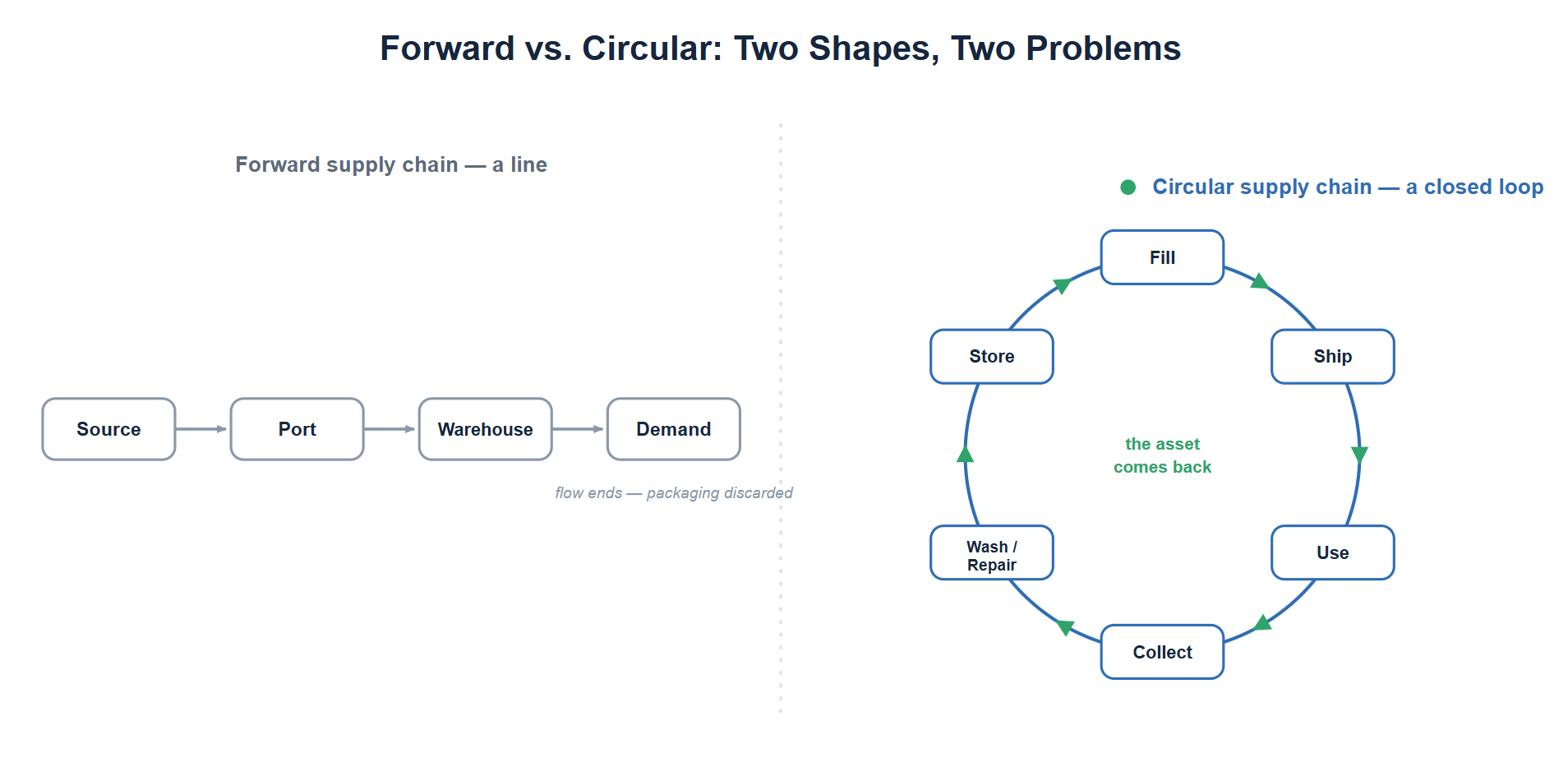
In a circular supply chain, arrival is only the halfway point.
The thing you are really optimizing isn’t the goods; it’s the asset carrying them. And that asset has a whole second life the forward model never accounts for: it has to be collected from wherever it was used, brought to a depot, washed or repaired, stored until it’s needed, and repositioned back to where the next shipment begins.
The network isn’t a line from A to B. It’s a closed loop that has to stay in balance in every period, the supply of clean, available assets has to meet the demand for them, in every location.
That single shift — from a one-way flow of disposable goods to a closed loop of durable assets — is what makes everything downstream harder.
| Forward Supply Chain | Circular Supply Chain |
|---|---|
| One-way flow | Closed loop |
| Product is the focus | Asset is the focus |
| Packaging is disposable | Packaging is reusable |
| Optimization ends at delivery | Optimization continues after delivery |
| Simple supply-demand balancing | Asset balancing across time and locations |
What Makes Circular Supply Chain Optimization So Hard
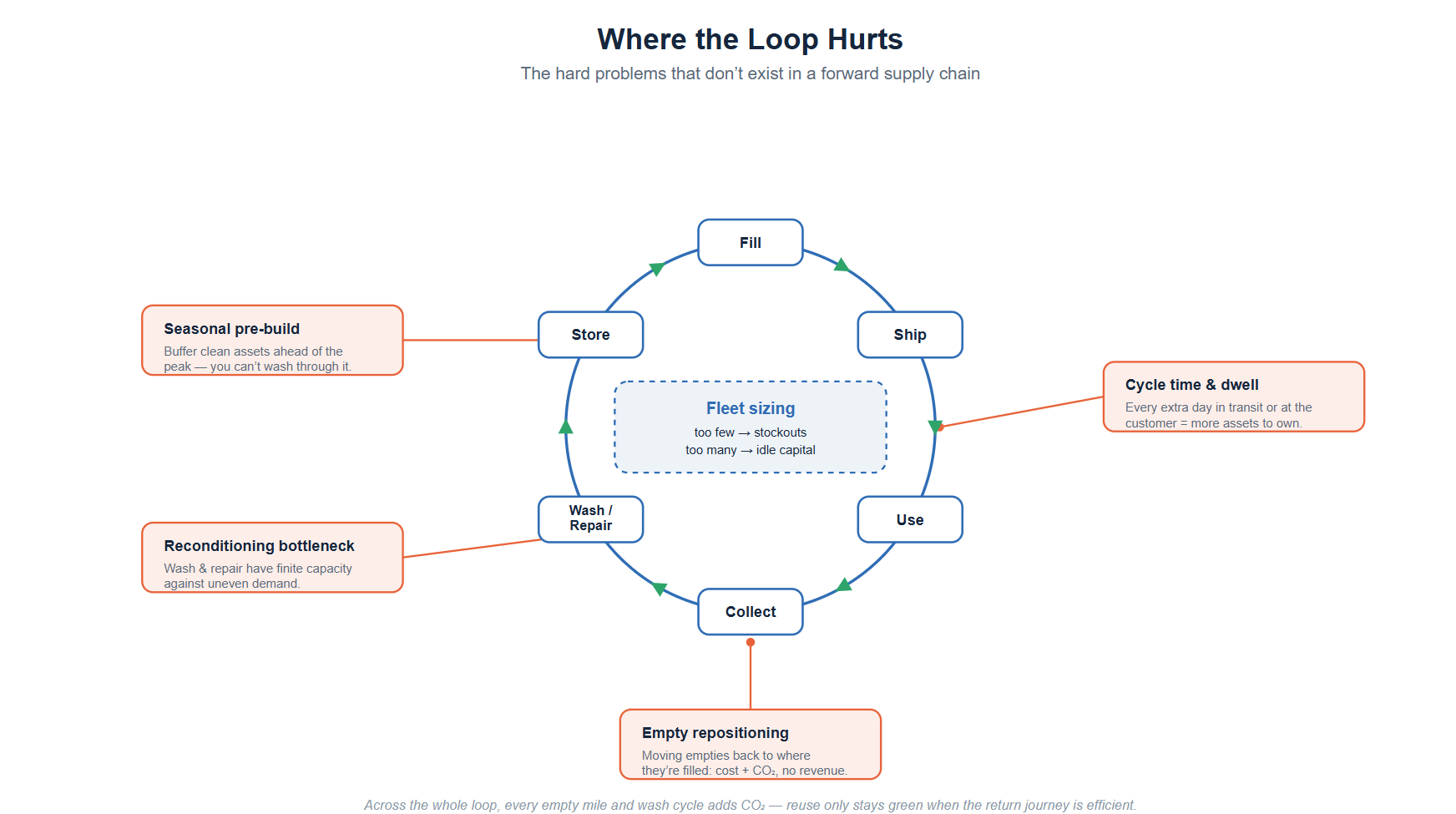
A handful of challenges define the problem, and none of them exists in a forward chain.
1. Empty repositioning
Empties accumulate where goods are consumed — retail regions, destination hubs, hospitals but they’re needed where goods are filled, at the grower, the plant, or the origin port. That mismatch forces you to move empty assets around the network: pure cost and pure carbon, with no revenue attached. It’s the same headache that haunts shipping lines repositioning empty containers, and it’s structural, not occasional.
2. Fleet sizing
This is a capital decision in disguise. Own too few assets, and you stock out — shipments wait, service slips. Own too many and you’ve sunk millions into a fleet that sits idle. The right number depends on how long each asset is gone for, how reliably it returns, and how many you lose to damage and shrinkage along the way. Get it wrong in either direction, and it shows up directly on the balance sheet.
3. The reconditioning bottleneck
Washing, inspection, and repair have finite capacity, and demand is rarely flat. A fresh-produce pool faces a harvest peak it cannot possibly wash its way through in real time; a pharma fleet faces launch surges. The only answer is to build a buffer of clean assets ahead of the peak — which means deciding, months in advance, how much to pre-position and where.
4. Cycle time and lead-time uncertainty
An asset is unavailable for the entire loop: outbound transit, dwell at the customer, the trip back, the queue at the wash line, and time in storage. The dwell at the customer is often the largest and least controllable piece — you don’t fully decide when a retailer hands your crate back. Every day added to that cycle is more assets you have to own just to hold throughput steady.
5. Reuse is not automatically green
This is the one circular-economy advocates least like to hear. Collecting, repositioning, and washing assets all generate emissions, and a poorly designed loop can quietly give back much of the carbon advantage it was supposed to deliver. Reuse only stays sustainable if the network is designed to keep the return journey efficient — which makes carbon a variable to optimize, not a box to tick.
Why Traditional Network Design Tools Fall Short
Most network design tools were built for the forward problem. They assume one-way flow, treat packaging as free or invisible, and have no native way to represent returns, reconditioning, fleet sizing, or the way one period’s leftover stock becomes the next period’s starting position.
You can bolt approximations on, but the model is then answering a different question than the one a circular network is actually asking, and it will hand you a confident, precise, and wrong answer.
The reality is simple to state and hard to model: a pooling network is a forward supply chain, plus a reverse supply chain, plus a fleet-sizing decision, all coupled across time. To optimize it, you need a tool that can hold all three at once.
How SC Navigator Optimizes Circular and Pooling Networks
This is exactly the class of problem SC Navigator is built for, and customers are already using it this way today.
1. Multi-period planning: Because the loop repeats on a monthly or quarterly rhythm, the model lives in tactical, multi-period planning so the seasonal stock-build, the pre-positioning of clean assets ahead of a peak, and the carry-over of inventory from one period to the next are all represented directly rather than approximated.
2. Lead-time offsetting: Lead time offset captures the time an asset spends in transit and processing, so a unit that’s still “out there” is never mistaken for one that’s available. The reconditioning step — washing, inspection, repair is modeled as a transformation between asset states, letting a used asset become a ready one through a real processing stage with real capacity and real cost.
3. Multi-objective optimization: Because cost, service, and carbon are rarely aligned in a loop, multi-objective and CO2 modeling let you find the balance point deliberately, instead of optimizing one dimension and discovering the damage to the others later.
The deeper shift is what happens after the first study. Because the cycle never stops, the network model doesn’t have to be a one-off consulting deliverable that’s stale the moment conditions change.
It can run continuously, a living digital twin of the loop that the team re-runs as demand, returns, and costs move. Circular network optimization becomes a repeatable internal capability rather than a periodic project.
The Return Journey Is the New Competitive Advantage
The companies leading the shift to circular supply chains aren’t winning because they decided to reuse their packaging. They’re winning because they learned to optimize the part of the chain everyone else ignores: the journey home.
As reuse spreads from sustainability pledge to regulatory baseline, the ability to design and continuously optimize a pooling network stops being an operational detail and becomes a competitive advantage and, increasingly, a compliance one. Getting the product there was never the hard part.
“The hardest part of a circular supply chain isn't getting the product to the customer. It's everything that has to happen for it to come back.”
See how SC Navigator helps you design and optimize circular and pooling networks across cost, service, and carbon.