
Blog Post

The $25 billion cost of being certain
Ford booked roughly $19.5 billion in EV-related charges in late 2025. GM added about $6 billion in early 2026. Both had made the right strategic call on electric vehicles and the wrong kind of commitment: plants, offtake agreements and joint ventures locked into specific jurisdictions before the rules were written. Then the Inflation Reduction Act, EU battery passports and Chinese export controls arrived, and the firms that had committed earliest and largest paid most.
That is the opening case in a new HBR article by Mesquita, Vassolo, Destarac and Choi (November-December 2026). Their argument: buffers and supplier diversification were built for a world where shocks were rare. When the rules themselves keep changing, you need a supply chain designed as a portfolio of real options, four of them. The option to defer large irreversible commitments. The option to abandon positions cheaply. The option to expand from a minimal foothold. The option to shift production between locations in weeks. The cost of holding the portfolio is the premium; the payoff is moving first when the rules change again.
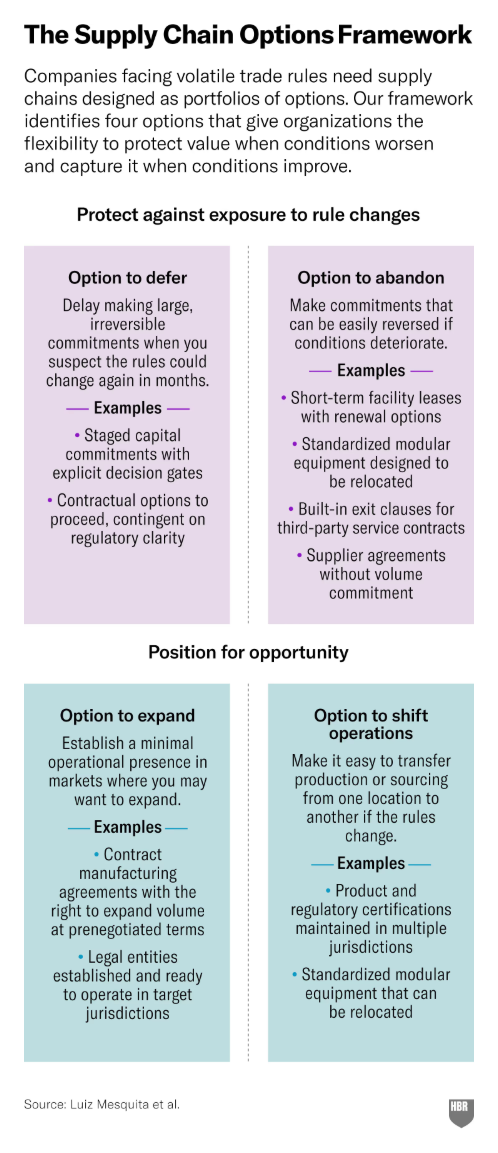
It is a good framework. It also contains a sentence that should worry anyone who runs a supply chain. In stable conditions, the authors write, you “commit to the lowest-cost configuration and optimize.” In volatile conditions the goal is “not to find the optimal configuration but to maintain the ability to reconfigure.” Their star case is a European manufacturer that runs small standardised plants on every continent because it is “not optimizing for cost; they are optimizing for flexibility.”
Read that last sentence again. It is still optimizing. It has changed the objective. What the article is actually attacking is single-scenario cost minimisation: one forecast, one tariff regime, the cheapest network, pour concrete. That is how Ford and GM got their battery plants. Flexibility was never the opposite of optimization. It was the thing left out of the objective function. And that distinction is where the next decade of supply chain design will be decided.
Design is becoming a practice, not a project
For twenty years, supply chain design meant a network study. Every two or three years a team of consultants or analysts would build a model, find the cheapest configuration for one demand forecast and one set of trade rules, present it to the board, and go home. Planning, meanwhile, ran weekly and monthly on top of whatever the last study had left behind. Design was strategic and occasional; planning was operational and continuous. The two rarely met.
The HBR authors’ own timeline shows why that split no longer works. Tariffs moved in 2018, 2019 and 2025. Carbon border fees in 2026. Sourcing thresholds escalating annually. If the rules change every twelve to eighteen months and the network study runs every thirty-six, every structural decision in between is made against a model of a world that no longer exists. The firms that adapted fastest in the article did not run a better study. They had stopped treating design as a study at all.
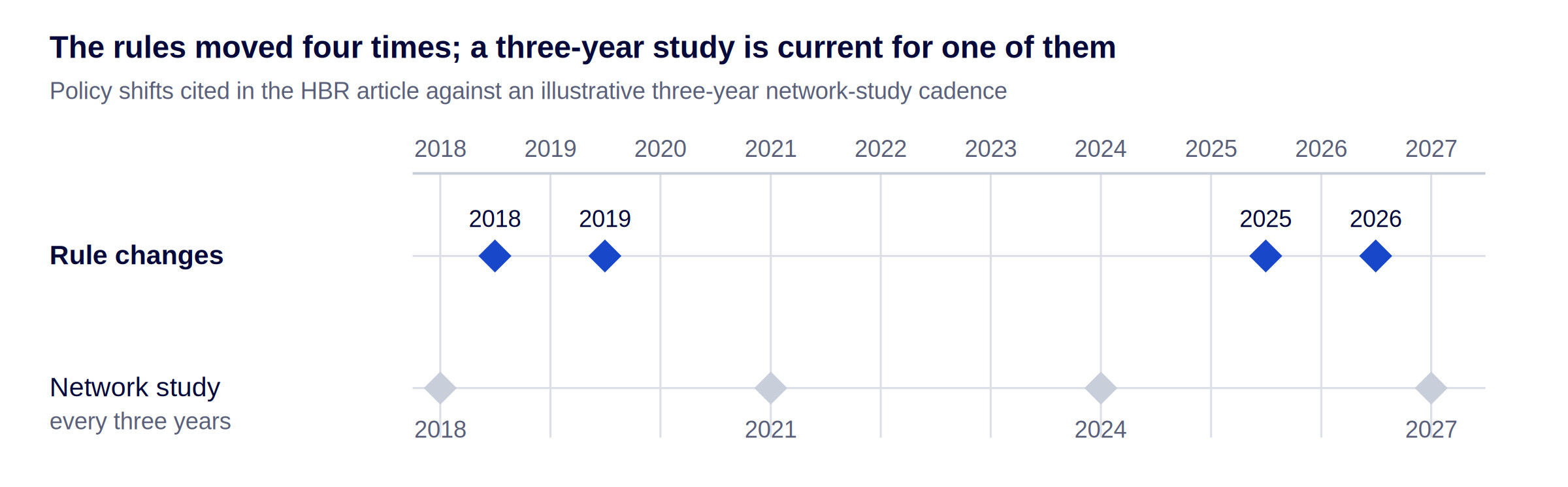
Figure 1. Policy shifts 2018 to 2026 vs a three-year study cadence
The policy dates are the article’s; the study cadence is illustrative, and it is generous.
That is where we see supply chain design going, and it is how we build. The structural model of the network, plants, suppliers, DCs, flows, costs and lead times, becomes a standing asset owned by the supply chain organisation rather than a deliverable owned by whoever ran the last project. The scenario set is refreshed when a policy is tabled, not after it lands. Commitments get re-scored when a tariff is announced. The same model that sizes the network also feeds the S&OP cycle, so the plan and the footprint are judged against the same numbers. And optimization is the engine underneath, because it is the only method that can take four futures at once and tell you what robustness against all of them costs, line by line.
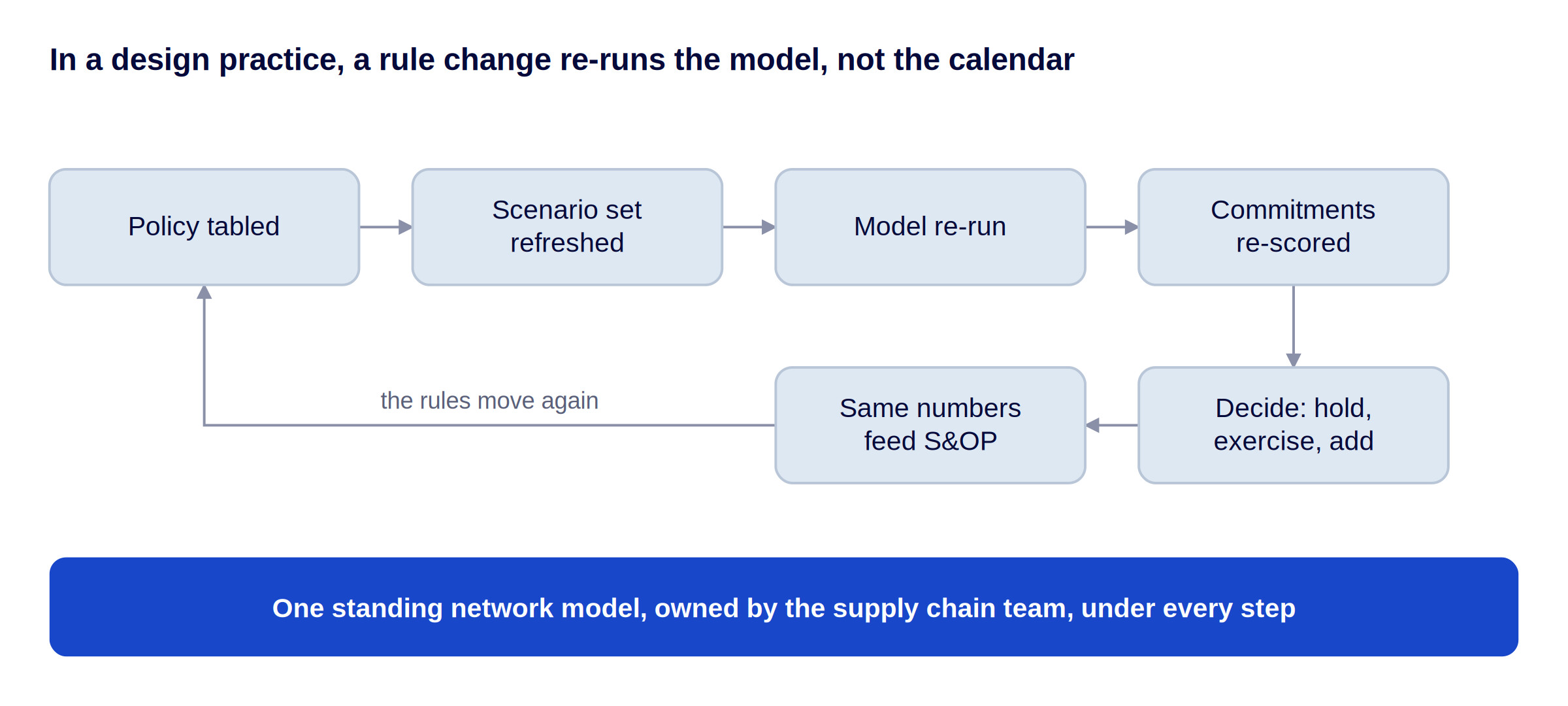
Figure 2. The design practice loop, 6 steps on one standing model
The loop closes on itself because the rules do; the model underneath is the only part that stays put.
That last point is the one that matters in the budget meeting. The article admits finance will see optionality as overhead and procurement as inefficiency, and advises leaders to “make the case.” A case made in adjectives loses to a CFO with a spreadsheet every quarter. A case made with the CFO’s own instruments, a scenario set, a cost delta and a probability-weighted exposure, is a different conversation. Real options work in finance because every option has a price, a strike and an expiry. In supply chain, almost nobody prices them. The practice we are describing is how you do.
What the practice looks like
Three shifts separate a design practice from a design project. None of them requires a new theory. All of them require a model that is kept alive.
| From | To | What it gives you |
| One forecast, one rule set | A scenario set of three or four plausible futures, refreshed as policy moves | The price of every option: what each commitment earns under current rules and what it costs under each alternative |
| Comparing end states | Modeling the transition: ramp curves, qualification lead times, dual-running cost | The expiry of every option: weeks from announcement to first compliant pallet, and whether that fits the window the rule gives you |
| A study every two or three years | A standing model, owned in-house, re-run when the rules change | Decisions made on the world as it is, and a flexibility budget finance can read line by line |
The second shift is the one most network studies skip, and it is where HBR’s framework is most useful. The authors note that qualifying a new supplier takes six to 18 months and that local production know-how “does not travel with the equipment.” An option you cannot exercise inside the policy window is not an option. A backup supplier with a twelve-month runway is worth nothing against a tariff announced with thirty days’ notice. Modeling the transition, not just the destination, is how you find that out before the tariff does.
The third shift is organisational, not technical, and it is the hardest. A standing model needs an owner, a cadence and a seat in the S&OP cycle. The companies we work with that have made this move tend to share a pattern: the network design capability sits with the supply chain organisation, not with a consultancy, and the people running it are the same people who answer when the board asks “what if the US tariff goes to 25%?” The answer comes back in days with numbers, not in a quarter with a deck.
Where AI fits, and where it does not
The article says AI is “beginning” to make the real-options approach tractable: systems that continuously score configurations against shifting tariff regimes and stress-test the whole portfolio at once. That is right, with two qualifications.
First, AI is useful here as the layer that keeps the model current and makes it answerable by people who are not modelers. Reading a tabled policy into a scenario, re-running the commitment table overnight, letting a VP ask the network a question in plain language and get a number back: that is where it earns its place, and it is what we built SENSAI to do on top of SC Navigator. What it does not do is replace the optimization underneath. A language model can describe a flexible network. It cannot find one. Finding the configuration that holds up across four futures, and pricing the premium, is a mathematical problem, and it is solved by optimization or not at all.
Second, as the authors say plainly, an algorithm can surface an attractive alternative in seconds but cannot qualify a supplier, train a local team or obtain a permit. The model tells you which options are worth holding and how fast you would need to exercise them. Building the capability to exercise them is still years of unglamorous work. The practice we described above is what makes sure that work is pointed at the right options.
Three questions for Monday
If you want to know whether your organisation holds a portfolio of options or a wish list, ask your team these. Each has a number for an answer. A paragraph is the diagnosis.
- Which three commitments in our network cost the most to exit, and under which plausible rule change does each turn from asset to liability?
- From announcement to first compliant pallet, how many weeks does our fastest shift take, and is that inside the window the rule would give us?
- When was our network model last re-run against a scenario set, and how many of the rules that matter have changed since?
HBR is right that the winners will be the firms with the discipline to pay for flexibility before they need it and the courage to defend that spend when finance pushes back. Courage is cheaper when you have the numbers. The firms that will fund optionality through the next three quiet quarters are the ones that can show what it costs and what it is worth, commitment by commitment, scenario by scenario. That is not conviction. It is a model with more than one future in it, run by people who own it.
If you would like to see what that looks like on your own network: